
Introduction
The business world is entering a new phase of artificial intelligence.
For the past few years, companies have focused heavily on generative AI. Businesses introduced AI chatbots, automated content creation, AI-powered customer support, coding assistants, and tools capable of generating text, images, software and reports.
But in 2026, the conversation is changing.
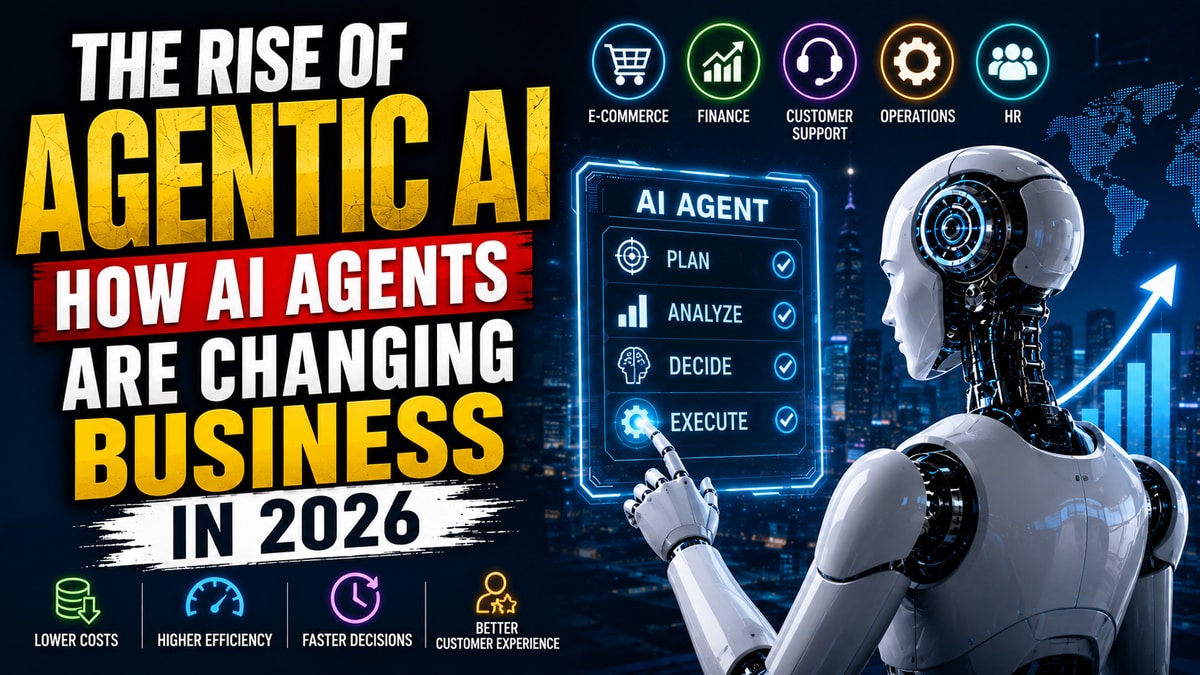
The next major development is agentic AI — artificial intelligence systems capable of doing more than simply answering questions. AI agents can understand objectives, plan multiple steps, interact with software, retrieve information, make decisions within defined limits and execute tasks.
This represents an important shift in the relationship between businesses and technology.
Traditional software waits for humans to provide instructions. Generative AI responds to prompts. Agentic AI attempts to take action toward a business goal.
For example, instead of asking an AI system "what products are selling slowly?", a business could have an AI agent continuously monitor inventory, identify slow-moving products, analyse customer demand, recommend discounts and prepare an action plan for management.
The difference may appear small. Economically it could be enormous.
Recent industry developments show businesses exploring agentic AI in finance, e-commerce, customer service, payments and enterprise operations. AI-powered shopping is also beginning to change how consumers discover and purchase products, creating new challenges for retailers that traditionally depended on direct relationships with customers.
The question is no longer whether AI will influence business.
The bigger question is how much of a business AI can eventually operate.
What is agentic AI?
Agentic AI refers to systems designed to accomplish objectives by taking a series of actions rather than simply generating an answer.
Imagine an employee receiving this instruction: find the best supplier for these 500 products, compare prices, check delivery timelines, review previous performance and prepare a purchase recommendation.
Traditional software would require the employee to perform each step manually. A generative AI assistant could help them analyse the information along the way.
An AI agent could potentially:
- Access approved supplier databases
- Collect current quotations
- Compare prices
- Check supplier history
- Evaluate delivery performance
- Identify risks
- Prepare a recommendation
- Send the result to an authorised manager
- Update the purchasing workflow after approval
That is the fundamental idea behind agentic AI.
It does not necessarily replace the employee. It becomes an additional digital worker capable of handling repetitive, multi-step activities.
Industry analysts increasingly identify agentic AI as one of the major technology themes of 2026, particularly in financial services, commerce and enterprise automation.
Why businesses are interested
Businesses ultimately care about four things: revenue, cost, speed and customer experience.
Agentic AI has the potential to influence all four.
Lower operating costs
Many businesses spend large amounts of money on repetitive administrative work.
Employees may spend hours on:
- Reading emails
- Entering data
- Preparing reports
- Checking invoices
- Updating CRM systems
- Monitoring inventory
- Responding to common customer questions
- Comparing suppliers
- Preparing routine documentation
If AI agents can safely automate parts of these workflows, companies reduce the amount of manual work required.
The objective is not necessarily to eliminate employees. It is to shift them from repetitive tasks toward work requiring creativity, relationships, judgement and strategic thinking.
Faster business decisions
Speed is becoming a competitive advantage. A company that understands customer demand today can react before its competitors do.
Consider an online retailer selling thousands of products. An AI system can continuously analyse sales, inventory, customer searches, returns, reviews, competitor pricing, seasonal demand and advertising performance.
An agent could then identify opportunities and alert management:
Demand for Product A has increased 35% during the last seven days. Current inventory may last only 12 days. Three suppliers can deliver within the required period. Supplier B provides the best combination of price and delivery time.
A human manager still makes the final decision. The important change is that the analysis happens continuously, instead of waiting for someone to prepare a weekly report.
AI agents are changing e-commerce
One of the most interesting developments is the emergence of AI-powered shopping.
Historically, consumers searched Google, Amazon, Flipkart or another marketplace, compared products and completed purchases manually.
AI assistants are beginning to change that process. Instead of searching for ten products themselves, a customer may tell an AI: I need a laptop for video editing under 80,000 rupees, find three good options and explain which one gives me the best value.
The AI can compare products, specifications, prices and reviews.
The next step is more significant still. AI agents could move from recommending products to helping execute purchases — what the industry is beginning to call agentic commerce.
Recent developments in the payments industry show companies preparing for a world where AI systems participate directly in shopping and payment experiences.
That could fundamentally change e-commerce.
The new problem for online businesses
For years, e-commerce companies focused heavily on attracting customers directly to their platforms. They invested billions in search optimisation, advertising, social media, influencer marketing, brand building, mobile applications and loyalty programmes.
Now imagine a future where consumers increasingly ask AI agents to decide where they should buy something.
The customer might never visit ten different websites. The agent performs the research and presents the best option.
This creates a serious strategic problem: who owns the customer relationship, the retailer or the AI agent?
Merchants are already thinking about customer retention and direct relationships differently as AI shopping assistants become more involved in product discovery and purchasing.
It means businesses may soon have to optimise not only for humans, but for AI systems reading on their behalf.
The rise of AI-ready businesses
The businesses that benefit most from AI may not be those that buy the newest AI software. They will be the ones with clean data and well-designed processes.
An AI agent cannot operate effectively when a company's information is scattered across disconnected systems.
Consider a company with customer information in one system, inventory in another, accounting in spreadsheets, supplier details in email and sales data in a separate application. An agent cannot easily understand that business at all.
So the AI revolution is also a data infrastructure revolution. Companies need:
- Integrated databases
- APIs between systems
- Cloud infrastructure
- Structured information
- Strong cybersecurity
- Access controls
- Reliable workflows
- Data governance
This is why enterprise AI is moving away from experimental pilots and toward integrated systems with real governance and accountability.
AI in financial services
Financial services could become one of the largest areas for agentic AI. Banks, fintech companies and insurers already process enormous amounts of information.
AI can assist with fraud detection, customer service, risk analysis, loan processing, financial recommendations, document verification, compliance monitoring and transaction analysis.
India's fintech sector illustrates the level of investor conviction. On 19 August 2026, Bengaluru-based Navi — founded by Flipkart co-founder Sachin Bansal — raised 100 million dollars from Prosus, its first outside capital in eight years, at a valuation of roughly 1.3 billion dollars. The investment came as the company prepared for an initial public offering reported at around 30 billion rupees.
At the same time, financial institutions must be far more cautious than ordinary consumer businesses. An incorrect AI decision involving a financial transaction creates immediate, concrete consequences.
Financial AI therefore needs human oversight, audit trails, security, explainability, regulatory compliance and permission controls.
The future is unlikely to be AI making every financial decision. It is more likely to be AI handling more of the workflow while humans retain control over the decisions that matter.
Small businesses can benefit too
Agentic AI is not only for large corporations. Small businesses could benefit even more, precisely because they have fewer people.
Imagine a small online business with five employees. An AI system could help monitor orders, customer messages, inventory, expenses, marketing, supplier communication and sales performance.
Instead of hiring separate staff for every administrative function, the company automates portions of the workload.
For an owner, that means less time on administration and more on customers and growth.
This matters particularly in India, where millions of small and medium-sized businesses are adopting digital tools. An expanding e-commerce ecosystem, mature digital payments infrastructure and growing internet adoption create an environment where AI-powered business tools could spread quickly.
The real competitive advantage
There is a common misconception about AI. Some businesses believe that simply adding the letters "AI" to a product makes it innovative.
That is becoming much less convincing.
In 2026, investors and entrepreneurs are asking a more demanding question: what problem does the AI actually solve?
Saying "we use AI" is no longer enough. The real advantage comes from combining AI with proprietary data, strong workflows and human expertise.
An AI chatbot is easy to copy. An AI system connected to years of proprietary business information, customer behaviour, operational data and industry knowledge is much harder to replicate.
That is what creates a durable moat.
New business opportunities
The rise of agentic AI is also creating openings for entrepreneurs. New companies can build specialised agents for specific industries.
AI sales agent
Identifies potential customers, researches companies, prepares personalised outreach and updates CRM records.
AI finance agent
Monitors expenses, flags unusual transactions, prepares reports and assists with cash-flow forecasting.
AI HR agent
Handles recruitment workflows, employee queries, onboarding documentation and HR administration.
AI procurement agent
Compares suppliers, monitors inventory and prepares purchasing recommendations.
AI customer support agent
Rather than answering FAQs, investigates customer problems, accesses authorised systems and initiates approved actions.
AI marketing agent
Analyses campaign performance, identifies trends and recommends changes to advertising strategy.
The opportunity is not building another general-purpose chatbot. It is building a system that solves one specific, expensive business problem.
The risks businesses cannot ignore
The biggest difference between a chatbot and an agent is action.
If an AI gives an incorrect answer, a person can ignore it. If an agent takes an incorrect action, the consequences are real.
A badly configured agent could send the wrong email, approve an incorrect transaction, modify customer information, order unnecessary inventory, provide incorrect financial information or expose confidential data.
Companies therefore need genuine safeguards, and agents should operate within clearly defined permissions.
Four questions are worth answering before any agent goes live:
- What can the AI see?
- What can it change?
- What requires human approval?
- What actions are completely prohibited?
These become more important, not less, as autonomous systems grow more capable.
Cybersecurity becomes more important, not less
An AI agent may hold access to valuable business systems. If attackers compromise the agent, they may reach everything connected to it.
Businesses need security architecture designed for AI-driven workflows, including role-based access, authentication, encryption, activity monitoring, audit logs, human approval steps, data-loss prevention, network restrictions and continuous testing.
The governing principle is simple. An AI agent should hold only the permissions it actually needs.
Will AI replace employees?
The honest answer is complicated.
AI will automate some tasks. Some jobs will change. Some repetitive roles will shrink. New roles will also appear.
Businesses will need people who understand AI systems, data, automation, cybersecurity, AI governance, business processes and human-AI collaboration.
The workplace may move toward a model where one employee supervises a set of digital workers. Instead of one person completing a hundred tasks manually, that person oversees systems completing many of them.
The value of human work shifts toward judgement, creativity, communication, leadership and accountability.
What businesses should do now
Companies should not rush into AI because competitors are using it. A better approach is to identify repetitive and expensive workflows first.
Five questions are a useful starting point.
What tasks consume the most employee time?
Look for repetitive activity.
Which processes generate the most errors?
These are often the strongest automation candidates.
What business data is already available?
AI becomes far more useful when information is structured.
Which decisions require human approval?
Define the boundaries before deployment, not after.
What measurable result should AI produce?
For example: reduce processing time by 40%, reduce customer response time, increase sales conversion, reduce operational costs, improve inventory accuracy.
AI projects should carry measurable business objectives like any other investment.
The future of business is not just artificial intelligence
The most important lesson of 2026 is that AI itself is not the destination.
The real transformation happens when AI becomes part of everyday operations — sales, finance, customer support, procurement, marketing, HR and logistics.
But successful companies will not simply automate everything. They will decide deliberately what humans should do, what AI should do, and where the two should work together.
That balance is becoming a competitive advantage in its own right.
Conclusion
Agentic AI is one of the most important business trends of 2026.
Generative AI taught computers to create. Agentic AI is teaching them to act.
That distinction could reshape e-commerce, fintech, customer service, logistics, marketing, HR and enterprise operations.
The companies that benefit most will not necessarily be those with the largest AI budgets. They will be the ones that understand their customers, organise their data, redesign their workflows and use AI against real problems.
For entrepreneurs, this creates a significant opportunity. For employees, a reason to develop new skills. For investors, a new generation of technology businesses to evaluate. And for consumers, it may change how we shop, how we deal with businesses and how we make purchasing decisions.
The business world is moving from software that waits for instructions toward intelligent systems that pursue defined objectives.
The companies that manage that transition responsibly may gain a considerable advantage.
The AI race is no longer simply about who has the smartest model. It is increasingly about who can turn intelligence into useful business action.