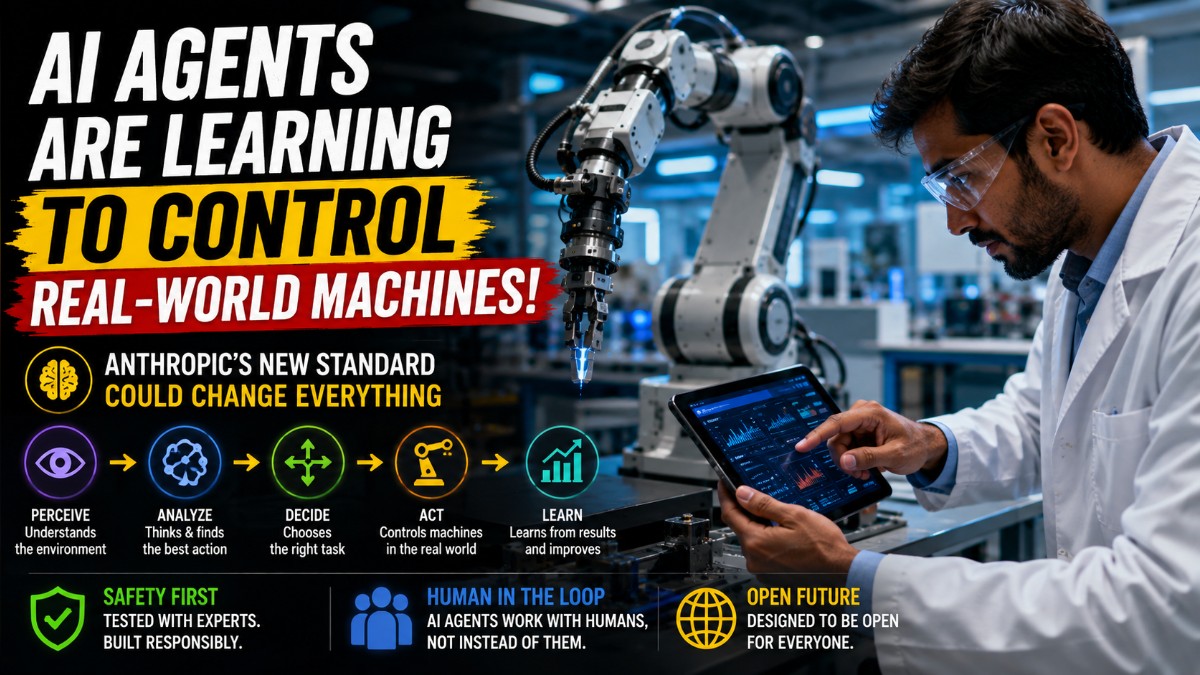

AI is slowly moving beyond computer screens, and Anthropic is working on a new technology that could help AI agents interact with physical machines. Anthropic has introduced the Model Hardware Standard (MHS) as a research preview. The standard is designed to provide a common way for AI agents to communicate with programmable physical equipment used in laboratories, research centres and advanced manufacturing. What is the Model Hardware Standard? At present, different machines often use different software and communication systems. Connecting laboratory equipment or industrial machines can therefore require separate integrations and a lot of development work. Anthropic's MHS is intended to solve this problem by giving AI agents a standard interface for communicating with different types of hardware. According to Anthropic, the system could reduce the time needed to connect AI agents with physical equipment from weeks or months to hours or even minutes in some cases. The AI agent can receive information about what a machine can do, which settings can be changed and what measurements are available. This allows the agent to understand the equipment before performing a task. AI agents could help with scientific experiments One of the main applications could be scientific research. An AI agent could potentially work with several machines during an experiment. It could start a process, analyse the results, adjust certain parameters and then continue with the next step. This could be useful in areas such as biotechnology, drug discovery, electronics research and advanced manufacturing. Instead of researchers manually operating every piece of equipment, AI could handle some of the repetitive coordination while humans continue to supervise the overall process. It could also be useful for robotics Anthropic has also demonstrated AI working with robotic equipment as part of its research. In one demonstration, Claude was able to work with a robotic arm to perform a task it had not been specifically trained for. This shows how AI agents could potentially use information about a machine's capabilities to perform new tasks. However, this does not mean AI can currently control any robot or machine without human supervision. MHS is still an early research project, and Anthropic is working with research laboratories, robotics companies and manufacturers to test the system and develop appropriate safety practices. MHS is not only for Claude Another important part of the project is that MHS is designed to be model-agnostic. This means the standard is not intended to be limited only to Anthropic's Claude AI models. Anthropic says compatible AI agents can access hardware through standard protocols, including the Model Context Protocol (MCP). If hardware manufacturers and other AI companies adopt similar standards, it could make it easier for different AI systems to work with the same physical equipment. Why this development matters The bigger change is the movement of AI from the digital world into the physical world. Most AI agents today work with software, websites, documents and other digital information. Technologies such as MHS could eventually allow AI agents to interact directly with laboratory equipment, robotic systems and factory machines. This could make some scientific and industrial processes faster and more automated. But there are also safety concerns. An AI making a mistake while generating text is very different from an AI making a mistake while controlling a physical machine. A wrong instruction could potentially damage equipment or create safety risks. Because of this, Anthropic is currently treating MHS as a research preview and is focusing on safety evaluations before wider deployment. What happens next? Anthropic is testing MHS with selected research labs, robotics companies and advanced manufacturers. The company has also said that it plans to eventually make the standard open source. If the technology develops successfully and receives wider industry support, it could become an important part of the emerging physical AI ecosystem. For now, MHS is still in its early stage. But the direction is interesting: AI agents are gradually moving from simply working with software to potentially interacting with machines in the real world.
Anthropic’s New AI Standard Could Let AI Agents Control Real-World Machines
Anthropic has introduced a new Model Hardware Standard that could allow AI agents to communicate with and operate physical machines used in laboratories, research and manufacturing. The technology is still in the research stage, but it could become an important step towards bringing AI into the physical world.